
Partnerships for Progress
AAI’S 2026 STATE OF EDUCATION ON AFRICA CONFERENCE
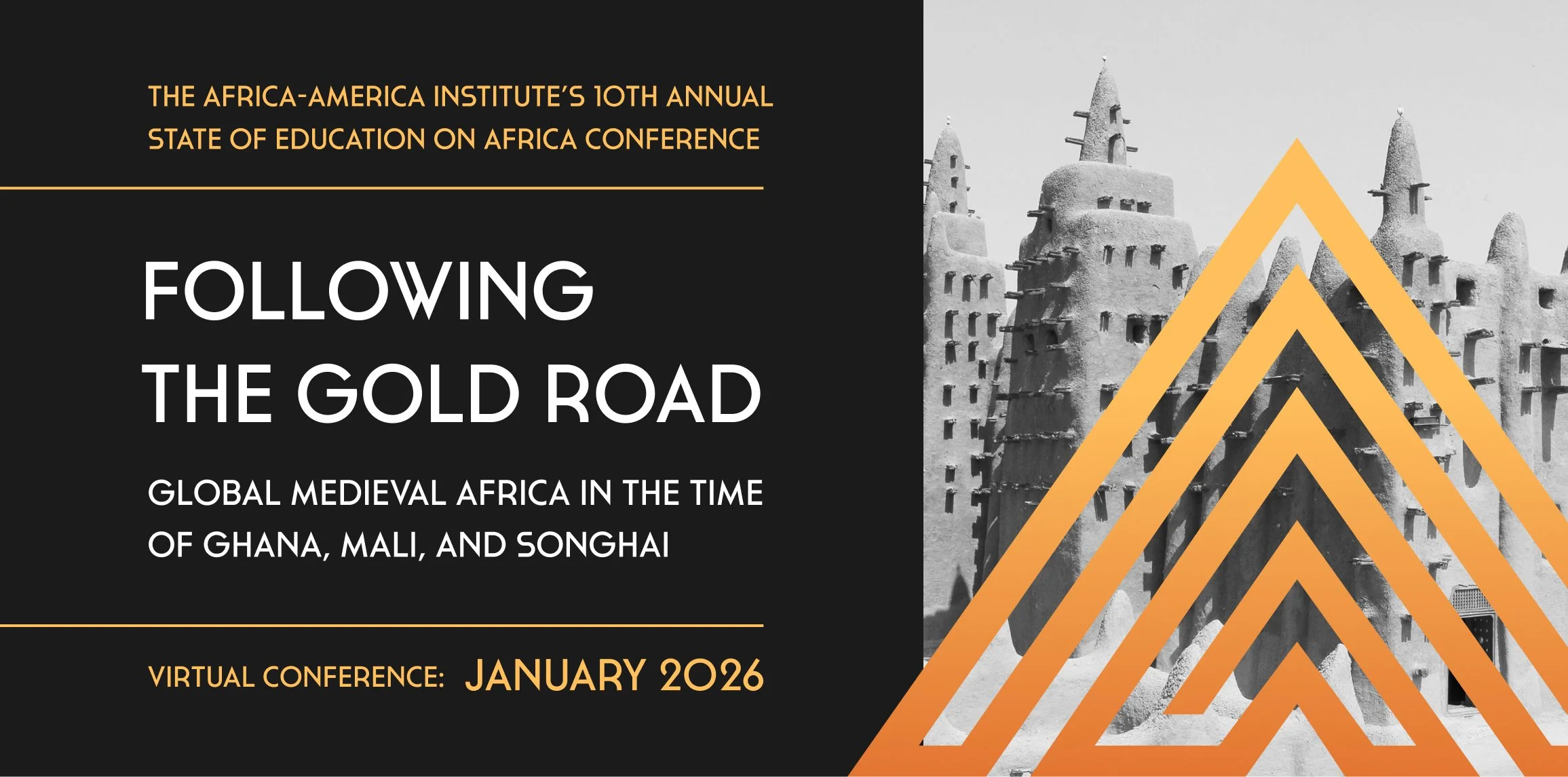
Following the Gold Road
Global Medieval Africa in the Time of Ghana, Mali, and Songhai
In partnership with Howard University’s Center for African Studies and Boston University’s African Studies Center, we are excited to announce our 10th Annual State of Education on Africa Conference
The Gold Road is a three-part lecture series for K-12 educators that explores the medieval West African empires of Ghana, Mali, and Songhai (6th–16th centuries). The program reframes global medieval history by centering Africa’s essential role in the world economy through its prized resource—gold—and by spotlighting its contributions to art, architecture, learning, and governance.
Under the theme “Following the Gold Road: West Africa and the Medieval Global Order”, the State of Education Conference (SOE) explores the centrality of ancient West African empires to the global economy. And while The Gold Road is especially useful for educators, it is a free conference open to the public, inviting all who are interested to participate.
Our annual SOE is grounded in the belief that the liberation of Africa and the Americas are inextricably linked, and that an unbiased and scholarly-based understanding of Africa’s history is essential to that connection.
Virtual Conference Sessions:
JANUARY 14, 2026: Geography, Technology, and Governance
West African societies harnessed key geographic features—such as the Niger River and Saharan trade routes—and innovations like iron smelting and gold mining to build powerful and enduring states. Dr. Gomez’s distinguished scholarship on African political thought and state formation will help illuminate how geography and technology shaped enduring traditions of leadership and governance across West Africa.
FEATURING:
Dr. Michael Gomez, Silver Professor; Professor of History and Middle Eastern & Islamic Studies and Founder, Association for the Study of the Worldwide African Diaspora (ASWAD)
Dr. Madina Thiam, Fannie Gaston-Johansson Assistant Professor of Africana Studies and History, Johns Hopkins Krieger School of Arts and Sciences
JANUARY 21, 2026: Gold, Power, and Global Trade Networks
Gold lay at the heart of the great West African kingdoms of Ghana, Mali, and Songhai—fueling trans-Saharan trade, drawing global interest from Europe and the Islamic world, and affirming Africa’s central role in the medieval global economy. Its legacy also set the stage for subsequent European colonization and the transatlantic slave trade. The conversation will illuminate how the historic Gold Road continues to shape patterns of wealth, power, and exchange in the contemporary global economy.
FEATURING:
Sarah Guérin, Associate Professor of History of Art, University of Pennsylvania
Yinka Adegoke, Editor, Semafor Africa
JANUARY 28, 2026: Ajami Manuscripts & Knowledge Production in West Africa
Medieval West Africa achieved remarkable knowledge and literacies, flourishing on trans-Saharan trade routes and embracing Islam as a cultural force. Despite this astounding history, for centuries, sub-Saharan Africa has been misunderstood as a largely illiterate region because of the Eurocentric definition of literacy as only the ability to read and write in European languages using the Latin script. However, millions of Africans have been reading and writing in both classical Arabic and their local languages, often using enriched forms of the Arabic script known as Ajami. This discussion invites scholars, educators, students, and the public to discover what can be learned from studying Ajami texts produced during this period of Africa’s history.
FEATURING:
Fallou Ngom, Professor of Anthropology, College of Arts and Sciences, Boston University
Dr. Gana Ndiaye, Assistant Professor of Ethnicity, Race, and Migration, Yale University